Sliding Tackle Drill Game to Practice Them Safely
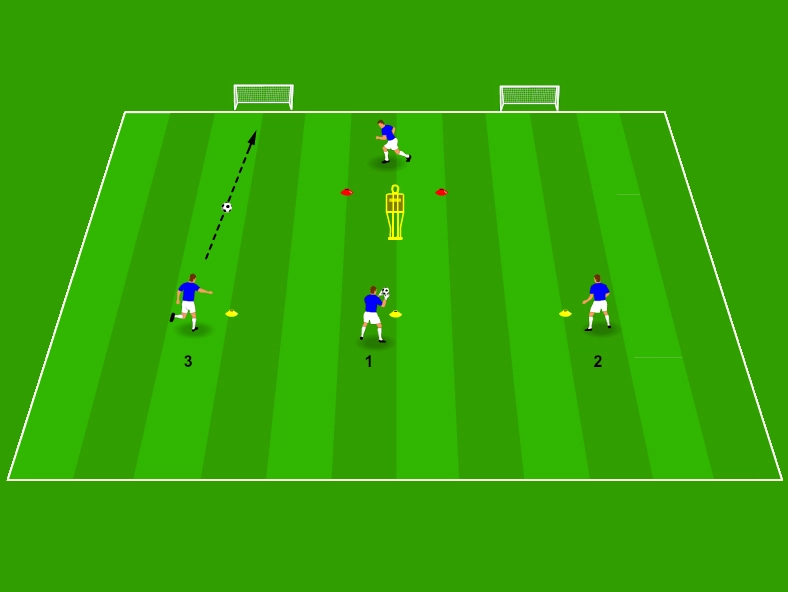
This sliding tackle drill is a competitive defending circuit that trains recovery defending, emergency blocks, and safer sliding technique under pressure. Use it when you want realistic last-ditch defending without turning practice into reckless challenges.
Setup
This drill is designed for 4 players, making it ideal for low-player training sessions, small group training, or short defensive blocks within a larger team session.
You do not need a full football pitch — just enough space to place three attacking stations and two small goals. Extra players can rotate in or act as servers if needed.
Set up three stations in a line or shallow arc. Station 1 (central) includes the mannequin/screen for the headed clearance. Stations 2 and 3 each face a small goal, with a cone line that controls when the attacker is allowed to shoot.
Equipment Needed
- 9 footballs recommended to run 3 rounds without interruption
- 2 small goals (cones can be used as an alternative)
- 1 mannequin (or 1 passive player acting as a screen)
- 5 cones minimum (to mark stations and the cone trigger lines)
Rules & Instructions
Run the circuit at a sharp pace, but keep every challenge controlled. Keep the sequence moving so the defender has to recover quickly between stations.
- Start Play:
- Start with the defender at Station 1.
- Play a throw-in to the defender so they can head it back over the mannequin/screen.
- Attackers:
- At Station 1, serve the ball to start play.
- At Station 2, shoot only once the defender’s foot crosses the cone line.
- At Station 3, apply the same shooting rule as Station 2.
- Receive a penalty point if you shoot before the defender’s foot crosses the cone line (Stations 2 and 3).
- Defender:
- At Station 1, head the ball back over the mannequin/screen.
- Concede a point if you fail to clear the ball cleanly at Station 1.
- Sprint to Station 2 immediately after the header.
- Block, tackle, or intercept the shot at Station 2.
- Recover again to Station 3 and defend the next shot.
- Restart:
- After each shot/save/out-of-play at Stations 2 and 3, play a new ball immediately.
- Keep 9 balls ready to complete 3 rounds without interruption.
- Collect balls before switching to the next defender.
- Rotation:
- Defender works Station 1 → Station 2 → Station 3 in sequence.
- After completing Station 3, the defender returns to Station 1 and repeats the circuit.
- Complete 3 rounds with the same defender.
- After 3 rounds, switch the defender with the Station 1 attacker.
- After the next 3 rounds, switch the defender with the Station 2 attacker.
- After the next 3 rounds, switch the defender with the Station 3 attacker.
- Continue until all players have defended.
- Record 1 point for each goal conceded, plus any penalty points.
- Declare the winner as the player with the lowest total points conceded once all players have defended.
Coaching Tips
- Recover on a curved line to reduce the shooting angle and arrive side-on.
- Stay on your feet first and use the slide as a last option.
- Keep your body shape open (side-on) and avoid frontal lunges.
- When sliding, go side-on, take ball-first contact, and commit fully with clean technique.
- As the attacker, hold the ball and time the finish around the cone-line trigger.
- Choose a safe surface and stop play immediately if technique breaks down.
Why It Works for Adult Amateur Teams
Adult amateur matches are full of imperfect moments: an attacker beats your line and you’re recovering, a poor clearance drops to an opponent, or you’re sprinting back toward your own box with seconds to defend. This drill recreates those last-ditch situations and forces defenders to recover with the right angle, delay the finish, and make a controlled decision on whether to stay up or slide.
Because the defender hits a third action while fatigued, the drill also reinforces calm technique under pressure — the exact moment where rushed tackling becomes dangerous and ineffective.
Key Outcomes
- Better recovery defending angles and emergency defending habits.
- Improved timing for blocks, tackles, and interceptions close to goal.
- Safer sliding tackle technique used as a controlled last option.
- More patient finishing and cleaner shot timing from attackers.