Individual Defending Drills: 5 Simple Exercises
Football is not only about scoring goals. Individual defending drills help players improve the moments where defending becomes personal, whether that is a direct 1v1, a recovery run, a cross into the box, or an attacker trying to turn in a dangerous area. The five drills below focus on those situations and can help make your team harder to break down.
Defensive drill 1 - Be physical
Perform this drill without a ball. Set up cones or markers to form a 15-metre by 5-metre grid. The attacker tries to reach the far side of the grid by evading the defender. The defender blocks the attacker with physical play, pushing them into less dangerous areas.
Standing too upright makes defenders easy to beat. They should bend their knees, stay low, and use their body, not their hands. The aim is control, not fouling. This drill introduces the physical side of defending before adding the ball.
Avoid giving attackers too much distance. Staying within arm’s length lets defenders close space and stay engaged. This drill also helps with set pieces, where defenders must hold their ground.
Defensive drill 2 - Facing the attack
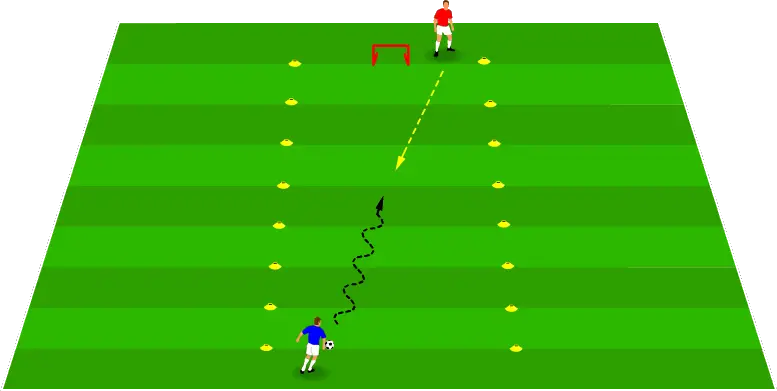
You will need cones and a small goal. Use the cones to set up a playing area of about 30 metres long and 10 metres wide. The defender stands beside the goal, and the attacker starts on the opposite side of the area with the ball.
The attacker’s objective is to score. The defender tries to deny any clear shooting chance by blocking the shot, pushing the attacker away from the goal, or recovering possession. This drill represents one of the most common individual defending situations in football: an attacker driving directly at the next defender after breaking a line.
For the defender, the key is not to rush in. Good defending in this situation usually starts by slowing the attack, protecting the central lane, and forcing the attacker into a less dangerous area. For the attacker, the drill is also useful because it develops dribbling, decision-making, and finishing under pressure. That makes it a useful practice for both players, not only for defenders.
For this drill and the following individual defending drills, defenders should also apply the ideas described in our previous article on defending one on one attacks.
Defensive drill 3 - Defending from behind
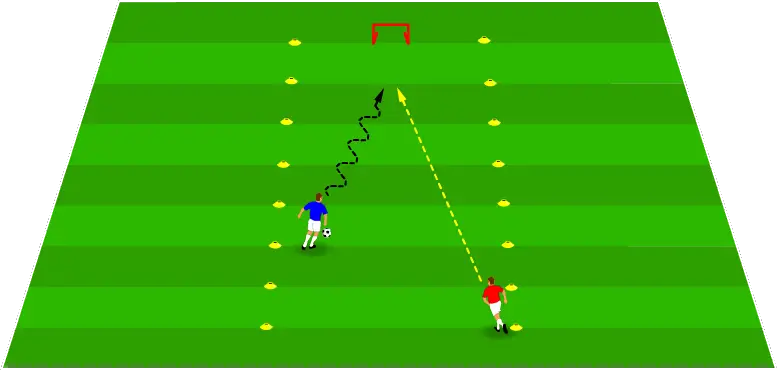
This drill is like the previous one, but both players start on the same side. The attacker gets a few steps’ advantage and can finish from close range.
This changes the problem for the defender. Instead of starting in front and trying to delay the attacker, the defender now has to recover from behind, close the gap quickly, and still defend under control. It is a realistic situation for transition moments, especially when a team loses the ball high up the pitch or when an attacker breaks through, and defenders have to chase back.
This exercise is helpful for both players. The attacker focuses on carrying the ball at speed and finishing under pressure, while the defender improves reaction speed, recovery angle, body use, and challenge timing. Slide tackling may appear in this type of action, but only when the defender is balanced and using the correct technique. Reckless tackles from behind are not the aim of the drill.
This is one of the best drills in this article for players who need to defend transition situations better.
Defensive drill 4 - Defending crosses
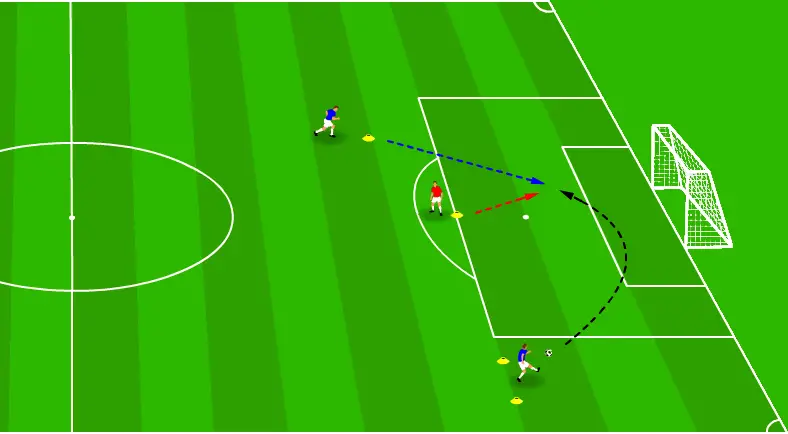
Three players complete this drill. Use a soccer field if possible. One attacker crosses the ball to a teammate running toward the penalty spot. The defender tracks the run and clears the ball first.
This is a more advanced individual defending situation because the defender must deal with two problems at once: the ball’s flight and the attacker’s movement. A common mistake is to focus only on the cross and lose sight of the runner. Defenders need to keep checking over their shoulders, stay aware of where the attacker is, and use body contact at the right moment to compete for the ball without losing balance.
Like the earlier drills, this one is useful for attackers as well. The crosser focuses on delivery, the runner on timing and finishing, and the defender on awareness and timing inside the box. Once all players are comfortable with the drill, you can increase the realism and difficulty by adding a goalkeeper.
This is an excellent drill if your team is conceding too easily from wide areas.
Defensive drill 5 - No turn
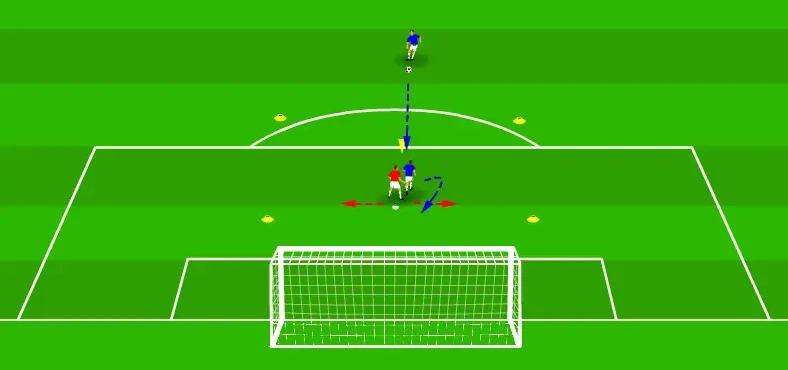
You will need three players to complete this drill. Use an actual soccer field if possible. One attacking player passes the ball to a teammate standing in the box with their back toward the goal. The receiving player tries to turn and score. The defender’s objective is to stop the attacker from turning and getting a shot away.
This is a very serious situation for centre-backs and defensive midfielders. Many dangerous chances come from attackers receiving in central areas, protecting the ball, and then spinning into a shooting position. The defender has to stay tight enough to feel the attacker, but balanced enough not to get rolled too easily. Good footwork, body position, and strength all matter here.
This is another drill that improves all players involved. The passer works on accuracy and timing; the attacker improves at receiving under pressure; and the defender develops the ability to deny the turn and protect the most dangerous part of the pitch. Once the players are comfortable, adding a goalkeeper makes the action more realistic and increases the pressure on the finish.
Final thoughts
These five drills help players defend with more control, awareness, and confidence. Good individual defenders are strong in tackles, balanced, able to delay attacks, recover quickly, judge danger, and prevent key turns.
Individual defending deserves focus, even at the adult amateur level. Organisational tactics matter, but decisive duels often determine outcomes. Use these drills as starting points, then refer to the in-depth guides above for deeper sessions.
Related Posts
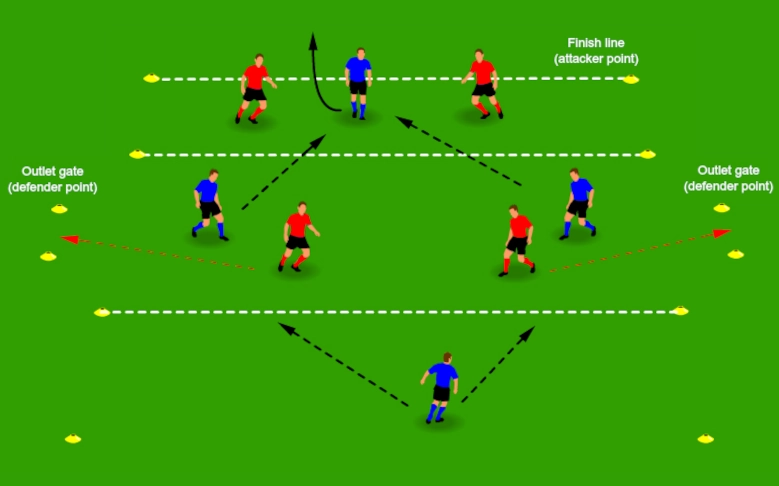
Progressive Passing Diamond: Breaking Lines
A competitive 4v4 diamond game to split a locked block, then drive over the finish line. Defenders score by winning it and playing out through outlet gates.
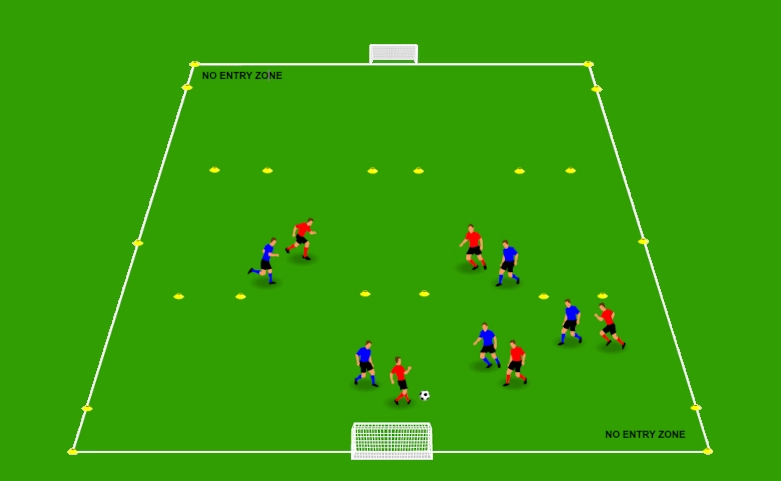
Gate Progression Football Drill: 2 Gates to Score
A competitive 5v5 progression game using three small gates per line, plus no-entry end zones to stop goal-hanging.
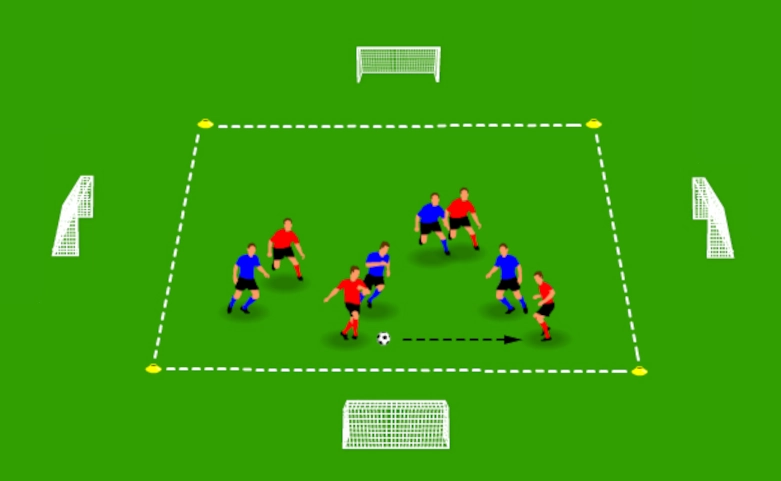
Rondo Pressing Drill - Win the Ball Back Fast
High-tempo rondo game that trains counter-pressing, clean regains, and fast transitions using a 12×12m grid, 4 mini-goals, 2 touches, and a 6-pass trigger.